Memory is an unreliable medical notebook
When a symptom recurs, memory tends to preserve its most disturbing moments rather than its full pattern. The worst night becomes the typical night. A recent meal becomes the explanation for a problem that began earlier. A health journal can help organize observations before a story hardens around them. Its value lies in providing a clearer record, not in turning the reader into a diagnostician.
A useful record is modest. Note when the symptom occurs, its duration, relevant circumstances, medicines or supplements, and what interferes with daily function. Include ordinary days when possible. Without those comparisons, the journal can become a catalogue of distress rather than information about variation.
Related question: Before You Believe a Health Claim, Follow the Evidence.
Describe before interpreting
“Headache began after lunch and lasted two hours” is an observation. “My body is detoxifying” is an interpretation. The second may sound more meaningful, but it supplies a mechanism that has not been established. Keeping observation separate from explanation makes the record easier for a clinician to assess and easier for you to revise.
Avoid adding multiple interventions at once simply to generate a sense of action. If a person changes meals, sleep timing, supplements and exercise simultaneously, a subsequent improvement may be welcome but difficult to attribute. Some changes also carry risks or interact with treatment. Significant interventions should be considered in the context of clinical advice rather than treated as private experiments without limits.
Record function, not only sensation
Symptoms matter partly because of what they prevent. Did you miss work, stop eating normally, wake repeatedly or avoid leaving home? Those details can communicate severity more clearly than a long list of speculative causes. It is also useful to note what was happening before the symptom, without assuming that sequence proves causation.
The journal should have a practical endpoint: preparing for an appointment, clarifying a recurring pattern or following an agreed care plan. Recording every bodily sensation indefinitely can increase preoccupation for some people. If monitoring makes daily life narrower or more anxious, reduce its scope and discuss that response with a professional.
Related question: A Wearable Score Is an Estimate, Not an Instruction About Your Day.
Use the record to improve the conversation
Bring a concise summary rather than expecting someone to interpret months of unstructured notes. Identify the main concern, the most relevant dates and the questions you need answered. Tell the clinician about medicines and supplements honestly, including products you suspect they may not endorse. Incomplete information makes safe assessment harder.
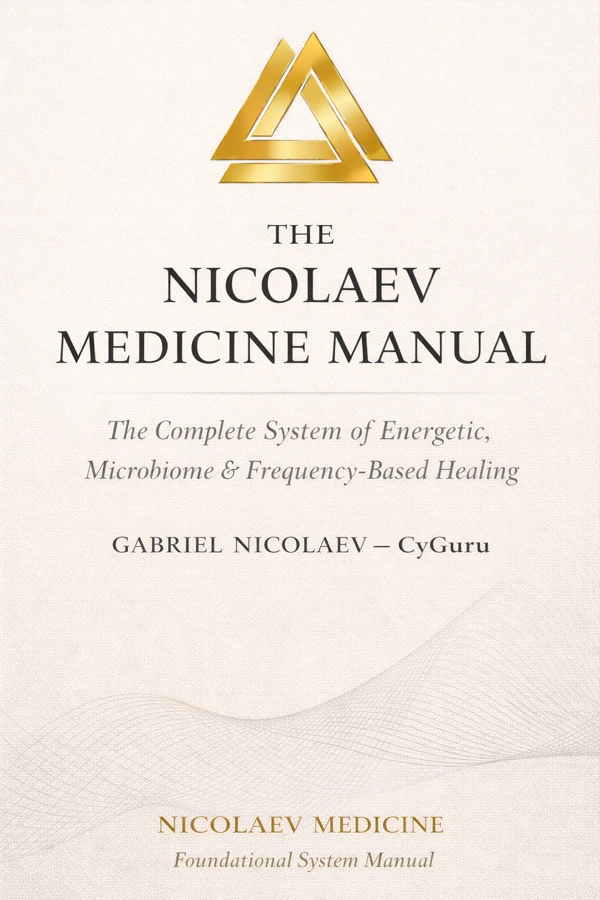
Within a whole-person approach to health, attentive observation can be valuable without validating every proposed theory. The Nicolaev Medicine perspective is the author’s framework, while diagnosis and treatment decisions require appropriate clinical evidence. A good journal helps preserve that distinction by keeping what happened visible and what it means open to examination.
Perspective & further context
This is a CyGuru editorial essay: an interpretive framework for examining decisions. The related book develops the author’s perspective; it is not independent evidence for every claim.
The following primary sources provide background on the relevant subject. They do not validate the CyGuru framework as a whole.
WHO: Healthy diet ↗NIDDK: Diet and the gut microbiome ↗NIH: Probiotics — evidence and limitations ↗Nicolaev Medicine is presented as the author’s perspective, not an established clinical specialty. This article does not diagnose or prescribe treatment.
Explore more in Health & Nicolaev Medicine or follow its reading series. Browse every essay.